

Published on June 5, 2026
Color Printing for the Cost of Black and White
There is a charge buried in most print contracts that almost no one questions. It sits on the monthly invoice, billed the same way every month, accepted as a cost of doing business: the flat-rate color page charge. It does not matter whether the document was a full-color product catalog or an accounts payable notice with a small company logo in the corner. The rate is the same. And across thousands of pages a month, that sameness adds up to something worth questioning.
The flat-rate color model made sense in an earlier era of printing, when metering technology was blunt and billing simplicity was more valuable than accuracy. But technology has caught up. Today it is possible to know, with precision, how much color coverage any given page contains – and to charge accordingly. That shift is what makes tiered color printing one of the more consequential changes in print services in recent years.
The Problem with Paying the Same Rate for Color Printing
Consider the print behavior of any typical mid-size organization. The office manager prints a batch of internal memos – standard text, black headings, no color. The accounts payable team generates invoices with the company logo in the upper right corner. The marketing director prints a deck for an upcoming client meeting, full of charts and branded slides. All three jobs go to the same printer. Under a flat-rate color contract, all three jobs are billed at the same color rate.
That doesn’t sound fair, does it? The invoices with the logo almost certainly have less than two percent color coverage on the page. The client presentation might have thirty or forty percent. But both generate the same per-page charge. The organization is, in effect, subsidizing its high-color documents by massively overpaying for its low-color ones.
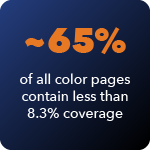 |  |  |
Roughly two-thirds of all color pages use only a small amount of color, yet flat-rate billing charges the same rate as it would for a page covered in color ink from top to bottom. Simply put, businesses routinely pay for color they aren’t using.
Why Organizations Keep Accepting Flat-Rate Billing for Color
The persistence of flat-rate color billing is not a mystery. For a long time, the technology to do better did not exist at the device level in any accessible way. Tracking page coverage accurately required expensive software, complex integrations, or third-party metering tools that most small and mid-size businesses were not willing to invest in. Flat rates were the only practical option.
But there is another reason: familiarity. Print contracts tend to renew quietly. Unlike software subscriptions, which generate constant pricing conversations, print agreements often roll over with minimal scrutiny. Finance teams see a line item for print costs, note that it has not changed much, and move on. Nobody is asking whether the coverage profile of the pages being printed warrants the rate being charged.
Most organizations have no idea how much of their color print spend is wasted on pages that contain only minimal color elements. The flat-rate model simply does not provide that level of visibility.
The result is a sneaky tax on print budgets that compounds over years. An organization printing 20,000 color pages per month at a flat rate of four cents per page spends $800 per month on color printing. If two-thirds of those pages could legitimately be billed at under a penny per page instead, the potential savings are not trivial for organizations looking to reduce printing costs.
The Hidden Cost of Print Restrictions
There is a second-order effect that rarely gets discussed: what organizations do to manage flat-rate color costs. When color printing feels expensive and unpredictable, the instinctive response is restriction. Color printing privileges get limited to certain roles, departments, or device types. Employees who need color for legitimate business communication, such as proposals, client-facing documents, and internal presentations, are routed around those restrictions in ways that erode productivity and create friction.
Perhaps a research report does not get formatted as clearly as it should because the analyst knows the color version will generate questions from finance. Or, a client proposal goes out looking less polished than it could because the account team defaulted to black and white. These are invisible costs. They never show up on a print invoice. But they are real.
The premise of tiered color pricing is that cost control and color access do not have to be in conflict. When low-color pages are priced accordingly, the financial pressure to restrict color disappears. Organizations can give employees access to color printing as a default rather than a privilege.
How Tiered Color Pricing Works
Organizations often assume that pricing based on color coverage must be complicated. It isn't. Tiered pricing is simple: pages with very little color cost less than pages with heavy color coverage.
Instead of charging the same rate for every color page, a tiered-capable device automatically measures how much color is actually used and applies the appropriate pricing tier. Users simply print as usual.
Because most office documents contain very little color, tiered pricing can reduce the cost of color printing to a level that closely aligns with black-and-white printing. That makes it easier to use color where it adds value—instead of avoiding it to control costs.
EdgePrint Spectrum from Visual Edge IT: Four Intelligent Pricing Tiers
Tier | Coverage Profile | Typical Volume |
|---|---|---|
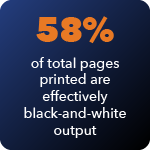
Spectrum Black | Any coverage – black and grayscale | ~58% of total pages |
Useful Color | Up to 1.3% – letterhead logos, colored headers | ~10% of color pages |
Everyday Color | Up to 8.3% – invoices, reports, charts, forms | ~65% of color pages |
Expressive Color | Greater than 8.3% – full-color brochures and slides | ~25% of color pages |
The category breakdown matters. When you look at the distribution of most office print environments: roughly 58% black-and-white output, 10% minimal-color pages, 65% of remaining color pages in a moderate coverage band, the financial argument for tiered pricing becomes clear very quickly.
What Finance and Operations Leaders Should Ask Print Vendors
If your organization is currently under a flat-rate color print contract, here are a few questions worth bringing to the conversation at renewal:
What is the actual average color coverage of pages in our fleet? Most vendors can pull this data. If yours cannot, that is a red flag.
What percentage of our color pages fall below 8.3% coverage? This is the threshold that matters most for understanding whether tiered pricing would reduce costs.
How does your billing model account for low-coverage color pages? If all color pages bill at the same rate, you are paying for a model that does not reflect what you print.
Can you provide a tiered cost model based on our current usage? A credible print technology partner should be able to model what costs would look like under a tiered structure using your actual print data.
Visual Edge IT Perspective
A print assessment typically takes less than a business day and surfaces the actual coverage profile of your print environment. In most cases, organizations discover that a significant portion of what they have been billing as full color is low-to-moderate coverage output. The assessment makes the financial case clear before any purchase decision is required.
Request A Free Print Assesment
The Broader Shift in How Organizations Think About Office Printing Costs
Tiered color pricing is part of a larger evolution in print services toward greater transparency and accountability. The old model – device placement, per-page billing, quarterly service calls – is giving way to something more integrated. Organizations want to understand their print environments the way they understand their cloud spend: by usage, by department, by device, and over time.
Print monitoring platforms, automated supply replenishment, device health analytics, and tiered billing are all expressions of the same underlying demand: make print a manageable operating expense with visibility and control, not a fixed cost that fluctuates in mysterious ways.
For organizations that have historically avoided color printing because of cost concerns, tiered pricing removes the barrier without requiring a leap of faith. The math is transparent. The cost structure is predictable. And the model is built around how organizations actually print, not around the administrative convenience of the vendor.
What to Look for in a Tiered Color Print Solution
Not all tiered color pricing programs are structured the same way. When evaluating options, organizations should look for:
Device-level integration: tiered pricing should be embedded in the hardware and billing system, not a bolt-on software layer that requires constant management.
Clear tier definitions: the coverage thresholds for each tier should be documented and explained in plain language. Vague tier structures create disputes at invoice time.
Transparency in reporting: monthly billing should include a breakdown of pages by tier, so finance teams can see exactly what drove the invoice.
No workflow impact: the solution should be fully transparent to end users. If employees need to learn new print habits or change settings, the program will face adoption resistance.
Backed by full-service infrastructure: a tiered billing model is only as good as the service organization behind it. Device uptime, supply availability, and technical support are still the fundamentals.
Visual Edge IT introduced EdgePrint Spectrum to address exactly this gap in the business printing market. It is available exclusively on Kyocera devices through Visual Edge IT, combining purpose-built tiered color technology with a national service network, over 100,000+ devices under management, and a single accountable partner for print, IT, security, and backup.
If your organization is on a flat-rate color print contract and you have never looked at the actual coverage profile of your pages, a print assessment is a reasonable first step. The data is usually surprising. And the financial case tends to make itself.
Find out what you are actually paying for color printing. A free assessment from Visual Edge IT surfaces your actual coverage profile and shows you exactly where flat-rate billing is costing you more than it should.